Newsletter · 27 September 2026
We packed away half their toys. Then they got better at everything.
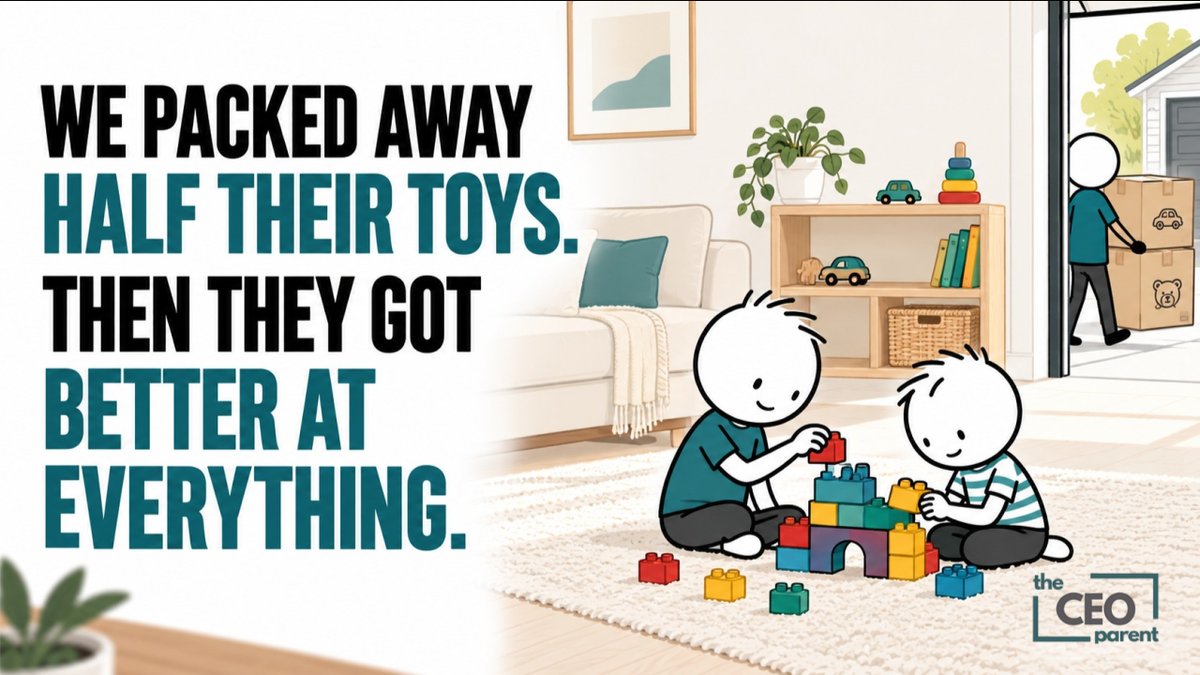
We're selling the house, which means every room now has to look like nobody with children actually lives in it. A magazine photo, not a household. So the toys went into boxes in the garage, not because the boys did anything wrong, but because a stranger walking through our living room shouldn't have to navigate forty Duplo bricks to find the sofa.
I braced for a mutiny. Instead, something happened that I did not expect.
Normally the boys have the run of a full toy room: Lego everywhere, cars wedged under the sofa and behind the curtains, a racetrack eating half the hallway, a dress-up box neither of us has the courage to open. It was organised, everything technically had a place, but there was a lot of it, and they played the way you'd expect with that much on offer. Ten minutes of Duplo, then the racetrack called, then a marker pen, then back to half-built Duplo, already forgotten.
Two or three weeks into a house with half the toys gone, that pattern has disappeared. They pick something, usually Duplo, and they stay with it. Not because we told them to focus, we never had that conversation, but because the thing that used to pull them away is no longer in the room. It's in a box in the garage. There's nothing left to wander off to.
That's the part most focus advice gets wrong. It was never really about willpower. My sons aren't exercising more self-control than they were a month ago; four and six year olds have exactly as much self-control as they always did, which is not much. What changed is what's physically in front of them. Take the racetrack out of the room and it stops competing for their attention, because it's genuinely, physically gone. Not a tab they could still click if the Duplo got boring. Gone.
I recognise this because my own desk does the opposite. I keep every option open at once, convinced that four things on the go makes me productive: the book, a client deck, the website, a LinkedIn post that has been "half written" for eleven days. My son at least has the excuse of being five. I do this with a fully formed prefrontal cortex and a business card that says I help other people fix exactly this problem.
Most advice here is about discipline: block your calendar, write a sharper priority list, try harder to ignore the noise. That solves the wrong layer. Discipline is what you need when the distraction is still in the room and you're relying on willpower to resist it. My sons didn't get more disciplined. The distraction left the building.
If your team can't stick with anything either, don't start with another conversation about priorities. Start by physically removing something. Close the project, archive the channel, cancel the recurring meeting. Take the fourth initiative and put it somewhere nobody can reach it for a month, and I don't mean the backlog, which is just a garage with a to-do label on it. The point isn't that people remember it's deprioritised. The point is that it stops being in front of them.
What's still sitting on your team's desk that should be in a box in the garage? Hit reply, I'd genuinely like to know what you'd remove first.
Ready to read more? Download the first chapter free at theceoparent.eu.